 Powersport Academy
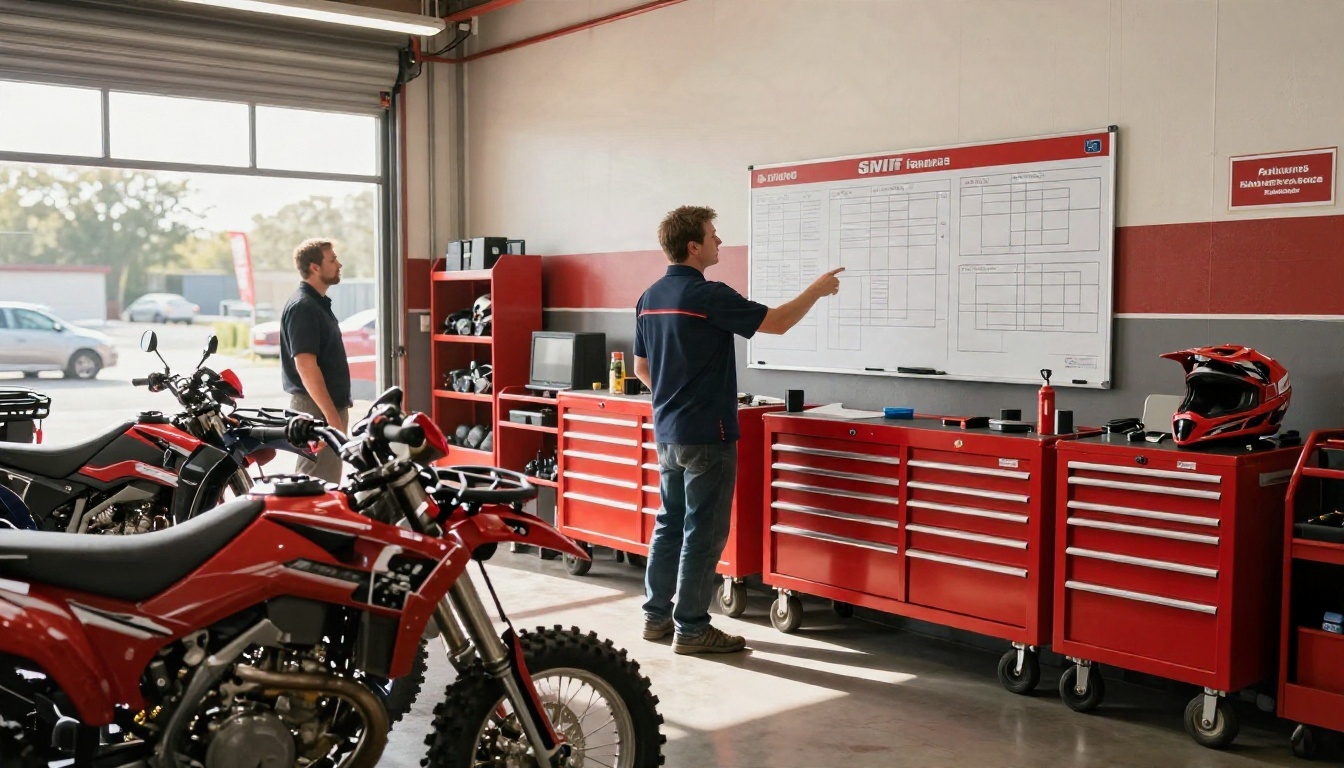
A packed service schedule can still hide hours of lost technician time. At HeroHub HQ, our Powersport Academy session focused on work planning and the interruptions that complicate Powersports service department management.
If you’re handling customer calls while technicians wait for answers, that pressure shapes the whole day. We started by putting those everyday problems on the table, before working through the processes behind them.
Key Takeaways
- Pickup delays, unclear repair requests, and repeated calls can take technicians and service staff away from scheduled work.
- The workbook exercises help attendees identify service problems, rate how consistently the department handles key tasks, and choose changes they can influence.
- The interruption calculations put an estimated value on lost time, but the figures are illustrative assumptions, not guaranteed sales or profit.
- Clear repair-order details, paperwork, and keys help technicians start assigned jobs without avoidable follow-up questions.
Inside HeroHub HQ: A Service Leadership Base Camp
Walking into HeroHub HQ for the first time, the immediate impression was how bright the space felt. The welcome was informal, with introductions, a few jokes about the heat being on, and a description of the room as a “service leadership base camp.”
Attendees had known about the class for roughly a month to six weeks. However, knowing a training session is coming doesn’t always mean knowing what to expect. Some were simply waiting to see who would attend and what would happen.
That’s why we established expectations early: no judging, everyone can make progress, and everyone should leave with an action plan.
The two-day curriculum covers practical Powersports Service Operations Management for service staff, including anyone working as a powersports service manager. By the end, the goal is to help staff plan and manage the service day with more control, rather than spend it running between phone calls, technician questions, and customer complaints.
That includes the difficult situations where customers bypass the service team and call the owner. We want the department to plan and execute the day without everyone feeling beaten up by closing time.
What Ducati and Suzuki Taught Me About Culture
My training approach grew out of years in dealerships and manufacturer roles. At Ducati North America, a motorcycle manufacturer, I was already teaching service operations as a contractor when the company needed someone to take over technician training and manage the program.
I accepted, went to Italy, and worked directly for Ducati for about five years. Across roughly 15 trips to Italy, I became immersed in the brand and the passion of the people at the factory. “Ducati e Passione” on the building captured how the place felt.
Later, Suzuki gave me the opportunity to manage a training team and work across motorcycle, marine, and automotive operations. It was a valuable learning experience, but the culture didn’t fit me.
That surprised me because I already loved Suzuki. I’d road-raced motorcycles for 20 years, owned around 40 GSX-Rs, and even had Suzuki tattoos. Yet the office felt different from what I’d expected. At Ducati, people rode Ducatis to work. At Suzuki, my boss rode a Harley.
I was already looking for an exit when the layoffs arrived.
The contrast mattered because enthusiasm for a brand doesn’t automatically translate into a good experience inside the organization. A dealership’s internal culture deserves as much attention as the image customers see.
The Workbook Starts With Your Actual Problems
Before getting far into the curriculum, we opened the workbooks to pages three and four. The first exercise captured attendees’ starting points, before training could influence their answers.
The questions were direct:
- What service problem takes too much of my time?
- What do I want my customers to experience differently?
- What change can I personally influence?
- Where does the department rely too heavily on me?
- What example or question would help us discuss the issue?
Next, attendees rated consistency on a scale of one to 10. The categories included hiring, onboarding, and coaching; job readiness; promotions and recommendations; delivery and follow-up; and ownership and management routines.
In this context, recommendations included upselling work. The exercise asked how consistently the department handles that activity alongside its other responsibilities.
These ratings weren’t a test with a passing score. They gave us a starting point for discussing where work gets delayed, where customers feel the effects, and which changes attendees can influence themselves.
Pickup Delays and Diagnosis Were Early Bottlenecks
A finished machine can still be difficult to deliver
Jared described customer pickup as one of the biggest drains on time. When a customer arrived, staff had to work out who would retrieve the machine and who would pull it out.
The physical layout added another problem. A second bay held three rows of machines, and the one needed often seemed to be the hardest to access. As a result, a routine handoff became a scramble involving people, space, and extra service inventory.

Illustration of the crowded-bay pickup problem discussed in class.
“Diagnosis” can describe several different problems
Another attendee identified diagnosis as the biggest challenge: getting a machine in, determining what it needs, and moving it toward completion.
However, that answer needed more detail. A diagnosis problem might involve gaps in mechanical diagnostics skills. It might also mean difficulty scheduling diagnostic work, or technicians feeling they should complete the repair immediately because the machine is already in their bay.
Each situation affects workflow differently. Completing a repair immediately after diagnosis can disrupt other scheduled work, even when the technician’s intention is to get something finished.
That led into a topic scheduled for deeper discussion the following day: the service sales funnel.
Uneven Workloads Affect Paychecks and Retention
We introduced the service sales funnel as a process for creating a steadier flow of work and revenue. The detailed process came later in the curriculum, but the reason for it was already clear.
When technicians describe their earnings as “good weeks, bad weeks,” scheduling and workload distribution often deserve a closer look.
One attendee had watched that happen after joining a struggling service department as a mechanic. He recalled a high week of around 190 hours followed by one near 30. From his perspective, the swings came from how the service counter scheduled and released work.
Those changes reach beyond the shop. A technician with a family has to explain why one paycheck is low and hope the next will make up for it.
Saying the money averages out over a year doesn’t remove the strain of alternating hardship and plenty. Household expenses still arrive, and repeated uncertainty affects morale.
Meanwhile, management may be working at the counter or meeting with the general manager while technicians in the back discuss which dealership they should work for next. Workload consistency affects shop culture, as well as production.
Putting a Dollar Amount on Interruptions
The workbook first used a smaller example: four interruptions lasting 20 minutes each. That’s 80 minutes per day, or about 26.7 hours across 20 working days.
At an example effective labor rate of $150 per hour, that represents roughly $4,000 in potential monthly labor sales.
Then we worked through a larger exercise using assumptions agreed on in the room. We used 15 minutes of lost time per technician interruption and a minimum of 10 interruptions per day. One attendee thought 15 daily interruptions would be common, but we stayed with 10.
Here’s how the class’s estimate developed:
| Calculation | Estimated result |
|---|---|
| 10 interruptions multiplied by 15 minutes | 150 minutes per day |
| 150 minutes converted to hours | 2.5 hours per day |
| 2.5 hours across five workdays | 12.5 hours per week |
| Annual time-loss figure used in class | 625 hours |
| 625 hours multiplied by $150 | $93,750 in potential labor sales |
The comparison with a roughly 2,000-hour full-time working year made the scale easier to see.
These are illustrative assumptions, not a promise that every dealership will recover that amount. The exercise gives the group a way to put a value on time that otherwise disappears into the workday.
Parts Sales Add to the Potential Opportunity
The $93,750 calculation covered labor alone. Next, we discussed the relationship between parts and labor sales.
The group agreed that a roughly even split was reasonable for the illustration. We rounded labor to $93,000 and added about $90,000 in parts, producing an estimated combined opportunity of $183,000.
That figure remained potential sales, not profit. It supported budget management decisions, including whether the business could hire another porter.
We also discussed owner conversations where a four-week service backlog becomes the reason the dealership believes it can’t sell more work.
In one example, I asked what would happen if a department operating at roughly 53% efficiency reached 75%. The immediate response was that the wait might shrink to three weeks.
A long backlog doesn’t show how much productive capacity is available. The exercise was about recognizing how much time might already be inside the department’s working day.
Higher Labor Rates Need a Profit Discussion
Labor rates also came up during the calculations. Attendees discussed figures including $139, $169, and $199 per hour. I mentioned dealerships charging $240 or $250 in some parts of the country, while others were still at $99.
I’m supportive of raising labor rates. I also support packaging services for customers.
A full-service package can carry a lower effective labor rate while the posted hourly rate remains higher. Those are different numbers, and the distinction matters when discussing what the department earns.
However, increasing the posted rate doesn’t make every additional dollar profit. The business still has to account for margins, gross profit, net profit, and the rest of the profit-and-loss statement.
A rate increase can be a useful start. It belongs in the same conversation as workflow and the hours the department can sell.
Calls and Rentals Compete for Service Time
The interruption examples quickly became familiar: questions, sales requests, and small jobs such as putting a license plate on a customer’s bike.
Rental operations added another layer. Staff described technicians getting pulled into rental needs, including checking equipment in and out. Rental check-out may also include verifying a renter’s driver’s license. Although rentals were treated as a separate business activity, they still used the same people.
One attendee wanted a way to assign a numerical value to that work so the businesses could account for it fairly.
Personal interruptions came up too. In technician training, I challenge people to consider what their own phone habits cost them, including whether leaving a cell phone in the glove box would help them keep working. Frequent smoke breaks also take time away from production.

Phone calls were one of the recurring interruptions raised during the session.
The phone problem crossed department lines
Staff described service advisors answering rental calls while finding parts, selling a part, or writing service. Calls also crossed between the parts department and service, so a parts manager or receptionist could route them to the right person.
One dealership had used a receptionist during the summer before she returned to school. The business was looking to hire someone full-time to direct calls, while overflow calls went to the office.
As attendees compared experiences, phone calls emerged as a shared problem. Their conversation gave us a clearer starting point than either person’s initial answer alone.
What Dealers Reported After Using the Training
I’ve used this kind of math-and-logic exercise since 2010. Wherever possible, I use the dealership’s numbers because the discussion needs a foundation the people in the room accept.
The session also included examples of dealers applying what they took home.
A Canadian dealer initially thought the ideas were unrealistic. Six months after attending training, the dealer reported doubling its service business.
At MotoCorsa’s Portland Ducati dealership, the service manager challenged the material throughout the session. After returning and implementing changes, he called about three months later to report that the service business had doubled.
The following year, MotoCorsa sent a different person to see whether another attendee would return with different action items. The dealership reported doubling the business again.
By the third year, the owner and general manager attended because they wanted to understand what their staff had been bringing back.
The connection was implementation. Attendees returned with action items that matched the problems and processes discussed during training.
A Job Needs to Be Ready Before It’s Assigned
Another workbook topic addressed “work that’s ready to begin.” Before assigning a job, we discussed confirming that the customer concern is clear and specific, with paperwork and keys ready. A service advisor or service writer should record enough detail on repair orders for the technician to start without follow-up questions. Warranty work may also need supporting documentation ready before assignment to meet applicable warranty requirements.
My shorthand is “paperwork, keys, go to work.”
“If you can’t go to work, you ain’t got a job.”
An unclear request may look like work on the schedule, but the technician still needs information before starting. A service manager can set a consistent standard for job-ready paperwork to reduce follow-up questions and interruptions.
I write detailed customer statements on repair paperwork, sometimes several paragraphs. “Customer states” should lead into what the customer said, with enough detail to help the technician understand the concern.
Naturally, that raises an objection: writing more takes time when the counter is already busy.
The process work addresses that concern. Clearer information and fewer interruptions are intended to create time elsewhere in the day. The extra effort up front has to connect to less confusion later.
The goal is to have enough control over the department to think about growth and planning. That might even leave room for a service-department social media post, rather than spending every hour trying to survive until closing.
Preparation Makes Difficult Work More Manageable
A conversation with Andres led into the effort required to build those habits. He described a basketball coach’s message about doing hard things well. It reminded me of a phrase I’d heard while working at Ducati: “Train hard, fight easy.”
The point was preparation before pressure arrives.
I remember dealership jobs where conflict filled much of the day. At a Chrysler dealership in the 1990s, I’d arrive around 6:15 a.m. to prepare for a 7 a.m. opening. Customers were already pulling up, lining the driveway, and knocking on the door.
Once we opened, the arguments could continue until closing at 7 p.m. Those experiences required work and repetition. A training session doesn’t remove that effort.
A century ride made the lesson concrete
When I lived in California, I typically rode about 75 miles a week across road and mountain-bike rides. I completed Bike the Coast’s 100-mile route and the San Diego Century, which involved more than 100 miles and roughly 7,500 feet of climbing.
During my first San Diego Century, I was among the last finishers. It was getting dark, the food vendors had left, and the parking lot was nearly empty.
One person with a bullhorn stayed to encourage me across the finish.
The following year, I returned and took two and a half hours off my time. Because I understood how demanding the ride was, I prepared for it differently.
That same expectation applies to difficult conversations: preparation takes work before the difficult moment arrives.
Conflict Resolution Starts With Managing Your Reaction
As we moved into conflict resolution, I made clear that nobody was leaving with a magic tactic that would make every conversation easy.
The first issue was taking things personally. Even after decades of experience, I still recognize that reaction in myself.
For example, when a client says an e-learning website feels slow or isn’t producing the sales they expected, my first response can be that we’ve failed them.
Yet building the website and selling the client’s courses involve different responsibilities. The client still has to create content that succeeds and do the work of selling it.
Understanding that distinction doesn’t automatically stop the emotional reaction. It takes practice to separate a customer’s concern from a judgment about yourself.
The next principle was empathy. That’s where this part of the session ended, as we began moving beyond our own reaction and toward the customer’s experience.
Frequently Asked Questions
What does the Powersport Academy session cover?
The two-day curriculum covers practical Powersports Service Operations Management. It focuses on planning and managing the service day, work readiness, interruptions, and service department processes.
How can a service manager reduce interruptions?
The session highlights consistent processes, clear job information, and ways to direct calls to the right person. These steps can reduce follow-up questions and help staff protect time for scheduled work.
What does the interruption exercise estimate?
The class estimated potential labor sales using assumptions about interruption length, frequency, working hours, and an effective labor rate. The estimate is illustrative and doesn’t guarantee recovered sales or profit.
What information should be ready before a technician starts a job?
The customer concern should be clear and specific, and the paperwork and keys should be ready. Repair orders need enough detail for the technician to begin without follow-up questions, with supporting documentation ready for warranty work when required.
Powersports service department management: Better control begins with the work already in the shop
The HeroHub session kept returning to the same issue: a busy department needs a clear view of where its time goes. Pickup delays, unclear jobs, and repeated interruptions compete with the work technicians are there to complete.
Our focus was recovering usable time through preparation and consistent processes. The aim is a service day staff can plan and manage, with room to think beyond the next interruption.