Even though we are largely virtual… we do hit the road.
As the founder of the Powersport Academy, I would be crazy for not taking the opportunity to unite my knowledge with the Marine Industry. This is why I was in Salt Lake City at the Lightspeed Offices for three days last week.
Now when I travel, I plan to enjoy the journey. I drove, took the mountain bike, and camped throughout Utah, Nevada, and California.
My other angle to the fun was the dealer visits. I love to share space with “Power-partners” of the industry and gauge where they are at and add value as we can. Using Powersport Academy’s first principles, we are able to ask deeper questions about perceived obstacles.

What are some red flags?
- Downtime between jobs – Routing the work and staging the work for technicians is something we see fall to the wayside all too often. If your technicians are looking for paperwork, parts, or the major unit… they aren’t turning wrenches.
- Misplacement of Shop Assets – Where is your bulk oil stored, your tire machine, tires, and battery charging station? If your shop assets are not placed with a step study or process in mind, you are most likely set up for failure.
- Sales Makes ALL our Profit and We Keep Losing Money in Service – I hear this a lot. In fact, I hear this so often from dealers that it makes you wonder how the idea of “Service absorption” ever came about. When I hear this, one of the first things I think of is… does Sales pay its fair share? (I’ll hit this in detail)
- Open RO Lists – It’s amazing what you can learn by reading through an Open RO List.
- Pet Projects – Here is where I get real with owners. If you want to be an enthusiast and run a hobby shop for your pet projects, funded by a third-party source, you can certainly do that. However, if this is your business, it needs to be tracked and run as a business.
Real Life Vs. Virtual
There is so much low-hanging fruit in the Powersports Industry that I still double down on keeping most of what we do – virtual. But then there is that extra level of visibility when we can see things in person.

When I stopped at Eurosports in Salt Lake City, I was impressed by a few things. One, the place looks great from the road. Both the Sales and Service inventory was kept in an orderly fashion. Sales was active. Their team was mobile, moving about and ready for action. I didn’t see any real desk-jockies while I was there.
If you’ve read my book “Action Leadership From the Edge“, you know how I feel about taking action.
Still about two wheels, I stopped at the Fezzari Factory in Utah. This was a great visit. If you have ever been to Ducati Dallas AMS and seen the retail / museum-type setup that Jeff Nash has… this was a similar thing. The displays of the new product were very clean and creative. The entry to Service was surgically clean, and they even had a museum featuring the historic products of their brand off to the side of their main showroom.
This facility is both manufacturing and retail… so seeing the way they tackled this with creativity, cleanliness and optimization of space was enlightening.
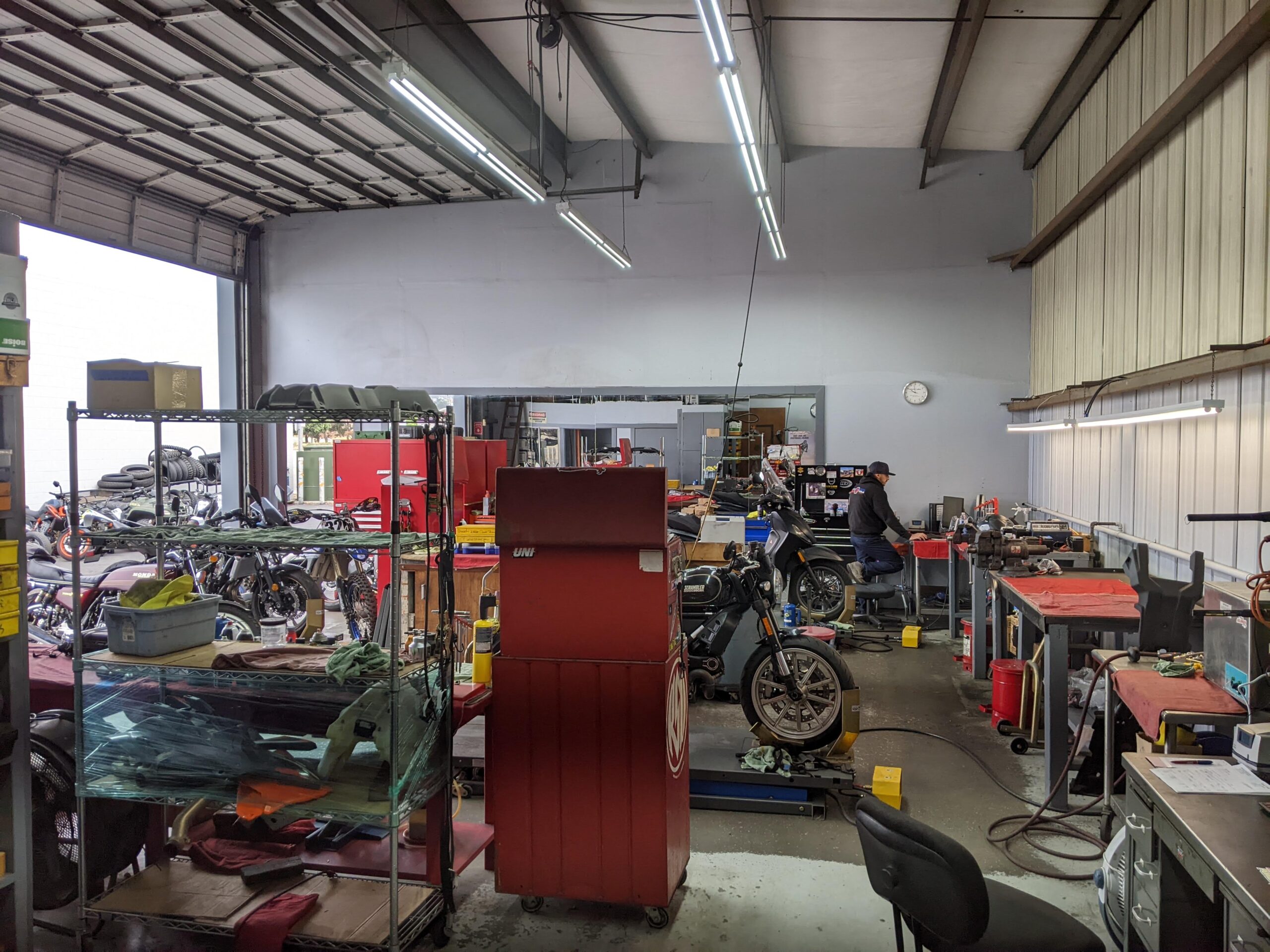
Monterey Peninsula Powersports was more of a Fixed Operations focus as I hung out there and made a full dealer visit out of it. Their situation is unique in that they have been expanding and adding brands… forcing their service department to assume a second building. These moves generally have teething issues, so what you read below is not a slam… but rather a case study on taking a wider-view approach.
The new building that the Service Department is using is a long rectangle, with the office at one end. This provides more challenge than a Square Layout, as things are more drawn away from one another.
In this case – physically, they have the tire machine, balancer, tires, batteries some storage shelves in the furthest bay from the office. They also have a closed room that is used for some kind of parts storage at the very end of the building past that bay.
Now this is just one case. If a technician has difficulty in singling out the required battery for a PDI Prep off the showroom floor, then needs to prep and charge that battery… you not only overly delay the shipping of the unit through sales (unless you choose not to properly charge the battery) but you rob the tech of productivity.

Let me explain. If the tech spends just 15 minutes trying to find the right battery and get it on the charger – everyone loses.
Let’s say the shop rate is $150.00
- 15 minutes is .25 hours
- .25 of $150 is $37.50
- Industry-standard loss for a distraction is .25… another $37.50
- If your shop is 50/50 on parts and labor sales — another $75.00 in lost revenue
So if you are reading this with me, you see that by not having the batteries organized, centrally placed, and staged for installation… this PDI/Prep is dinging the Service Department $150.00 in lost revenue opportunity.
Now blow that out across however many units this store processes for Sales…
- 100 Units a year – $15,000.00
- 200 Units a year – $30,000.00
- 300 Units a year – $45,000.00
Now this seems almost too simple. Move the battery storage to a more central location, closer to the high-dollar techs that are doing the work. Organize the batteries by size and model in a First-in/first-out fashion with one of each model pre-charged and ready for installation.
When a tech grabs a battery, members of staff that are more affordable, or in a support role… will unpack and prep the next battery in line for that model. This will require sturdy shelving, a clean prep area, and a premium multi-channel charge station. But if it creates the opportunity above, the investment readily pays for itself.
Did You See the Formula?
When I consult with dealers, this is typically how I operate. What is the struggle? What is a Root Cause? How will it impact shop culture to make a change? Will that change drive revenue or margins?
How do I measure the potential? I use the shop rate plus parts to gauge the upside of opportunity based on a time savings proposal.
Note the question about culture. Sometimes making more money isn’t worth the decision to do so. Measure your team and yourself before making too many changes. Measure everything. Know your numbers, so that when you change something, you can evaluate the win or loss in the numbers.

Potential vs. Reality
Changes we propose create potential. It is up to the shop to act on the potential. If we consult you on a change to reduce distraction and create a 2.5-hour per day opportunity. You need to seize that opportunity. Sell that labor. Bill the time.
If potential turns to beers and hacky-sack… the changes are moot.